The Cheapest Robot Wins
Tesla isn't building a better machine. It's building a cheaper factory. That distinction will matter more than anything else happening in tech right now.
Sometime in early May 2026, the last Tesla Model S rolled off the Fremont, California assembly line. No fanfare. No ceremony publicly announced. Just the quiet end of a fourteen-year production run for a car that, more than any other single object, convinced the world that electric vehicles were real.
The workers who built it are still there. The building is still there. The machinery is being dismantled.
What replaces it is a robot that will, if everything goes according to plan, eventually make those workers unnecessary.
There is something worth sitting with in that image before we get to the numbers.
What Tesla Actually Announced
Strip away the superlatives and here is what is factually happening:
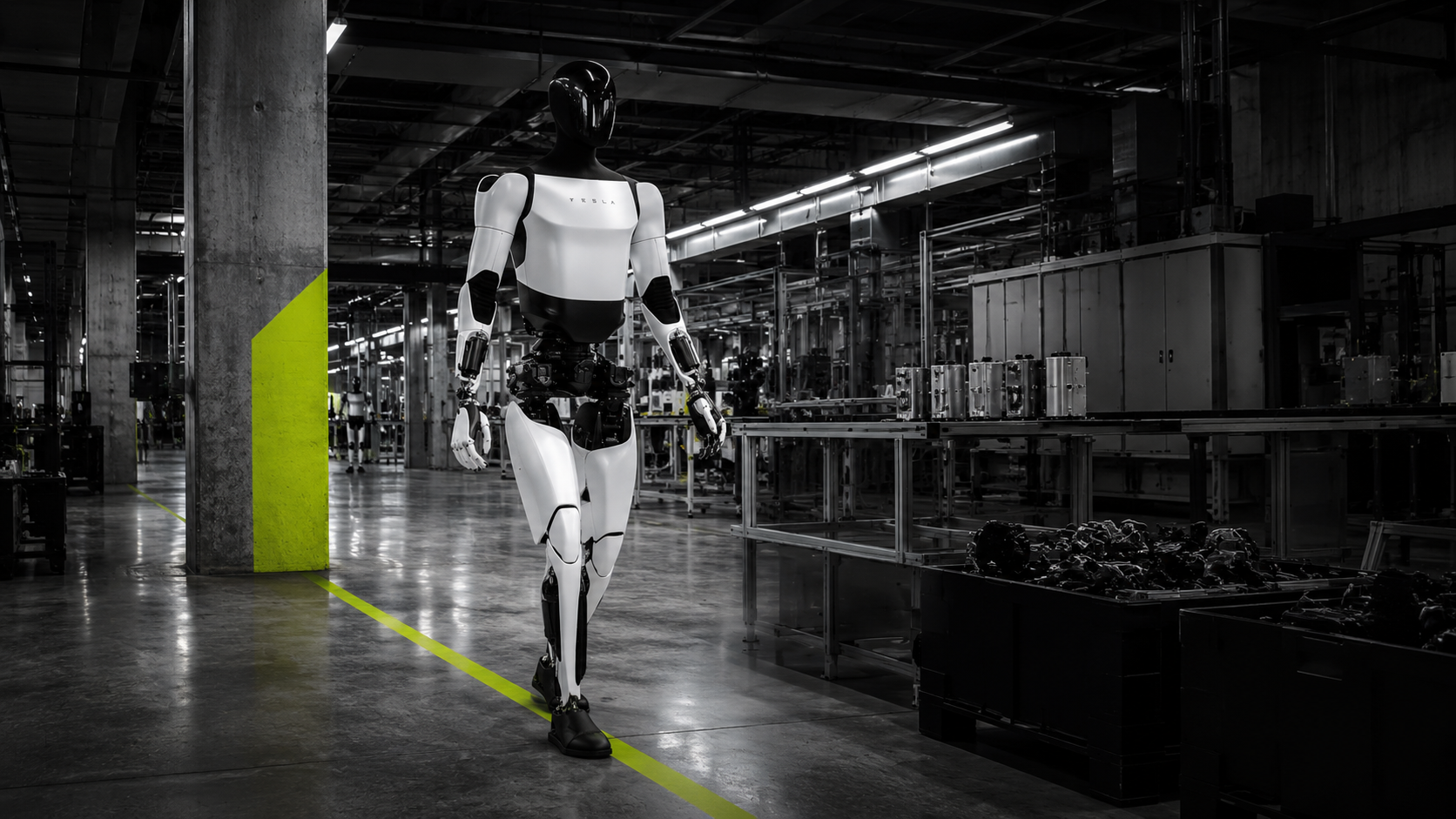
Tesla has ended production of both the Model S and Model X to convert its Fremont facility into its first large-scale Optimus humanoid robot manufacturing line — designed for a capacity of one million units per year. Simultaneously, at its Gigafactory in Austin, Texas, the company is breaking ground on a second facility: 5.2 million square feet, targeting ten million robots per year at full build-out.
Total capital expenditure for 2026: over $25 billion. Roughly triple what Tesla spent in all of 2025.
The Fremont line is expected to begin production in late July or August. Elon Musk, characteristically, warned it would start "quite slow" — adding that the rate was "literally impossible to predict" given the robot contains ten thousand unique parts across an entirely new production system.
That last admission, buried in the Q1 2026 earnings call, is the most honest thing said publicly about Optimus in years. Hold onto it.
A Short, Necessary Primer on Why Robots Matter Differently Now
We have had industrial robots for sixty years. They have been building cars, welding seams, painting chassis, moving pallets in warehouses since before most of us were born. And yet manufacturing employment, while reshaped, did not collapse. New jobs replaced old ones, mostly.
So why does this moment feel different? Why are economists, labor theorists, and factory workers paying closer attention than usual?
The answer is form factor.
Traditional industrial robots are fixed. They are bolted to a floor, optimized for one precise task, and completely helpless outside their programmed range of motion. Reprogramming them for a new task is expensive. Moving them to a new facility is expensive. They are brilliant, inflexible specialists.
A humanoid robot is designed to operate in spaces built for humans — using tools built for humans, navigating obstacles humans navigate, performing sequences of tasks humans perform. It does not require a factory to be redesigned around it. It walks in, picks up what needs picking up, and does the job.
This is not a marginal improvement. It is a category shift.
When economists talk about general purpose technologies — the steam engine, electricity, the microprocessor — they mean technologies that do not just improve one industry but restructure the cost of doing almost everything. Humanoid robots with sufficient capability and sufficiently low cost have that profile. Not because of science fiction scenarios, but because of arithmetic: if a robot can perform the physical tasks of a $50,000-per-year worker, costs $25,000 to purchase, and works continuously without benefits, the productivity math is not subtle.
The question — always the question — is the if.
The Gap Between the Promise and the Factory Floor
Here is where the MAN/MACHINE lens matters, because the coverage of Optimus has been almost universally insufficient in one specific way: it treats Musk's production targets as the story.
They are not. The gap between those targets and reality is the story.
In January 2025, Musk announced Tesla would build ten thousand Optimus robots that year. By January 2026, he acknowledged that zero Optimus robots were performing "useful work" in Tesla's factories. The units deployed internally were learning — collecting data, refining movement, building the training sets that will eventually make them functional. That is legitimate and important work. It is not production.
Current manufacturing cost per unit is estimated at $50,000 to $100,000. Musk's publicly stated target for consumer pricing is $20,000 to $30,000. That gap — between what it actually costs to build one today and what it needs to cost to be commercially transformative — is the entire ballgame.
Tesla has closed gaps like this before. The Model 3 launch in 2017 was a production disaster that nearly bankrupted the company. By 2020 it was the best-selling electric car on earth. The institutional knowledge Tesla has accumulated about scaling complex manufacturing is real, hard-won, and genuinely uncommon. That is not nothing.
But the Model 3 was a car. Tesla knew how to build cars. Optimus has ten thousand unique parts, requires continuous AI inference to function, must balance dynamically on two legs in unpredictable environments, and needs to perform useful physical work autonomously — not via the teleoperation that powered several of its most celebrated public demonstrations.
These are not the same problem.
The Manufacturing Bet, Clearly Stated
What Tesla is actually doing — beneath the $10 trillion revenue projections and the Mars deployment timelines — is a specific, falsifiable manufacturing wager:
That the same vertical integration strategy, supply chain leverage, and iterative production scaling that made Tesla the lowest-cost electric vehicle manufacturer in the world can be applied to humanoid robotics.
Its competitors are not other American tech companies. They are Boston Dynamics (owned by Hyundai, robots currently priced around $150,000), Figure AI (backed by Microsoft and OpenAI, also in the $100,000+ range), and increasingly Chinese manufacturers like Unitree, whose G1 model is already shipping commercially at $16,000.
That last number should be read carefully. Unitree is not building the most capable robot. It is building a capable-enough robot at a price point that makes conversations real. Tesla's bet is that it can get to $20,000–$30,000 with a meaningfully more capable product, at a scale no one else can match.
If it can, the market does not split evenly. The cheapest credible option in a new general-purpose technology category tends to define the category.
The Human Equation Nobody Is Solving
Return, for a moment, to Fremont.
The workers retooling that facility are not being laid off. Tesla confirmed as much. Headcount may actually increase during the conversion phase. There is real work in building the thing that will, eventually, do the work.
But the economic logic of humanoid robotics at scale points in one direction, and everyone in that building understands it without needing it explained. The productivity gains that make robots economically attractive are, by definition, reductions in the human labor required per unit of output. That is not a malfunction of the technology. That is the technology working.
The serious policy question — one that mainstream tech coverage almost entirely avoids — is not whether this transition will happen. It is whether the productivity gains will be broadly distributed or narrowly captured. History on that question is mixed, at best.
The Industrial Revolution eventually raised living standards across the board. It took roughly a century, considerable suffering, and the invention of the modern labor movement to get there. The digital revolution compressed that timeline somewhat and distributed gains more unevenly. Humanoid robotics at the scale Tesla is projecting would be a faster and more direct displacement of physical labor than either.
What institutions and policies govern that transition is a question for the society, not for Tesla's earnings calls. But it is the question that gives the ten-million-units-per-year target its actual weight.
What to Watch
The Fremont line beginning production in late July or August 2026 is not, by itself, the milestone that matters. "Starting production" and "producing meaningful quantities of robots that do useful autonomous work" are different claims. Tesla's own Cybertruck took over a year to go from first unit to meaningful volume, and that was a vehicle built on an existing automotive platform.
The milestone that matters is the first verified deployment of Optimus robots performing revenue-generating, autonomous physical work — not demonstration tasks, not teleoperated showcases, but repeatable productive labor that shows positive unit economics.
Musk himself framed it correctly, for once, in late 2025: if Tesla demonstrates Optimus performing genuine useful work in its factories by end of 2026, the transformation becomes plausible. If it misses that, the timeline extends in ways that affect everything downstream — investment, competition, workforce planning, policy.
The Texas facility targeting ten million units per year is a vision statement. The Fremont line starting this summer is the first real data point.
Watch Fremont.
The Bigger Picture, Quietly
We are living through a period in which the pace of technological change has genuinely outrun most people's frameworks for understanding it. Not because people are unsophisticated, but because the changes are arriving faster than institutions, narratives, and mental models can absorb them.
Tesla building robots in a factory that used to build cars is a compressed version of that larger story — old categories giving way to new ones, familiar objects (a beautiful sedan, a skilled job, a way of organizing a production floor) being replaced by things that do not yet have fully understood shapes.
The appropriate response to that is neither panic nor uncritical enthusiasm. It is the same thing good engineering requires: clear-eyed attention to what is actually happening, honest accounting of what is known versus projected, and enough patience to wait for the factory floor to tell the truth that the earnings call cannot.
The machines are coming. The interesting question was never whether. It was always: on whose terms, at what cost, and with what benefits.
That question is now being answered in Fremont. Slowly, at first.