Log Zero
Launching a column is an act of faith: a digital window onto what keeps our minds burning. For this debut, the radar points straight to Venice.
The word “experience” is no longer enough. The digital avant-garde is no longer arguing over formats or interfaces. Today, many of the most relevant creators on the international circuit are working on the exact same questions that keep technology companies awake at night: perception, interaction, data, attention and human connection. Contemporary art has spent decades investigating these territories, exploring what happens to a person after interacting with a work. Do they think differently? Does a behavior change? Are they moved, or do they feel a sense of belonging?
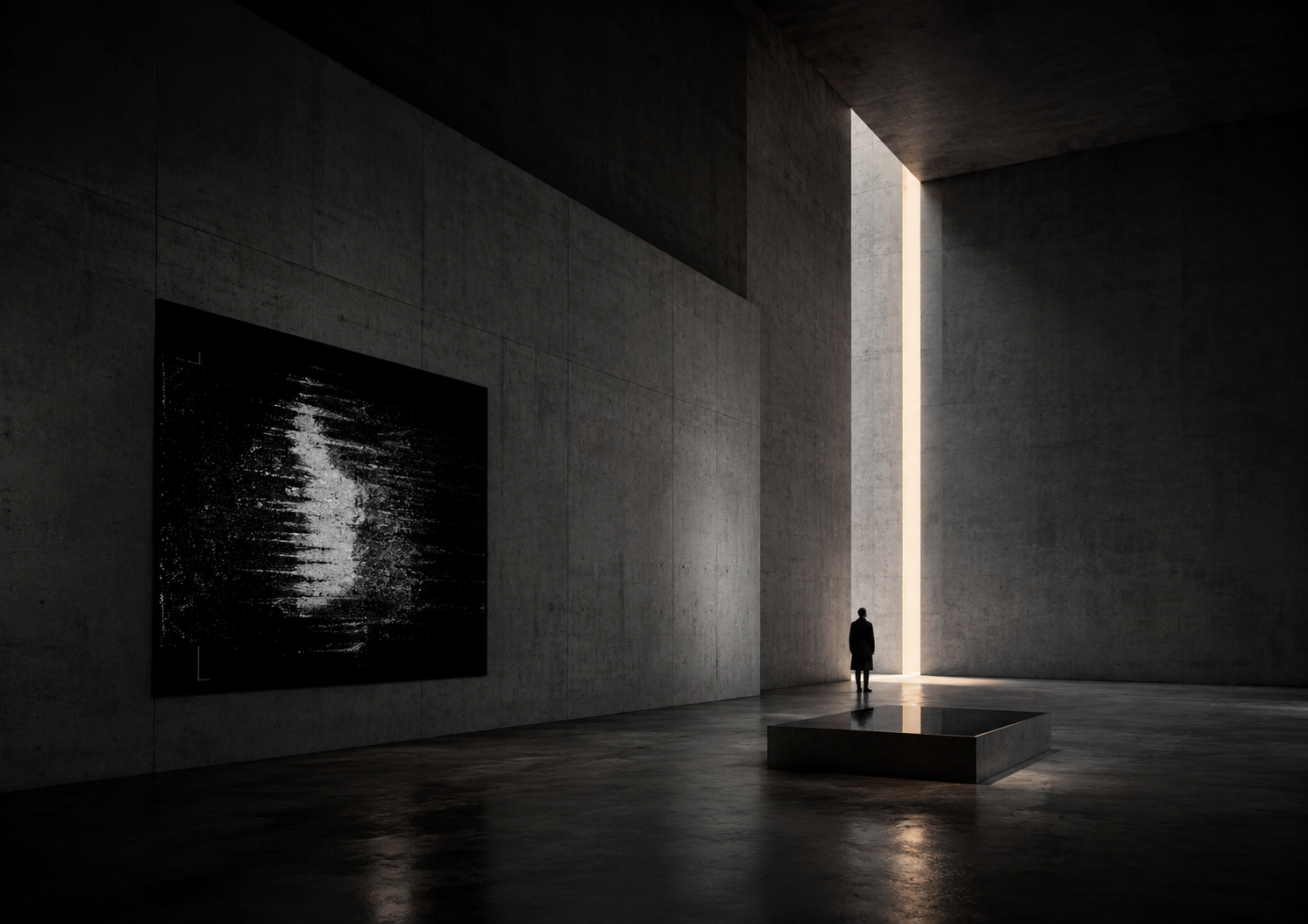
Building bridges is the greatest challenge facing art today, and the mission now is to build them directly toward new states of mind. That is why, when we learned that the 2026 Biennale — shaped from the curatorial vision of Koyo Kouoh — is titled In Minor Keys, everything clicked. The exhibition, which is already moving the world and will continue to do so through November, demonstrates precisely this: technology today dissolves in favor of transcendence. The artists brought together use digital media — video art, sound installations, immersive environments and software — not as a technological end in itself, but as connective bridges. The digital avant-garde renounces the noise of screens and visual spectacle in order to operate on a different frequency.
What is contemporary digital art if not a composition in minor keys? It is not about the brightness of pixels, but the vibration of code.
This art does not seek to dazzle in high fidelity; it resonates in the lower frequencies, passing through our zones of vulnerability and awakening states of pure attention. It is digital art at its most intimate: it cannot be touched; it happens in the air, in light, in a pixel or in a sound. It is the perfect bridge Kouoh was seeking: a subtle vibration with the power to rewrite memory and modify perception from the most absolute immateriality.
The British artist Chris Levine picks up that thread. During the opening week of the 2026 Venice Biennale, Levine pushed it to an extreme with Higher Power, a site-specific light installation projected into the sky above San Clemente: he repurposed military-grade laser technology to emit a visual message associated with deep contemplation and peace. He uses high-powered lasers, programming and advanced optical systems not to create a light show, but to compose a luminous frequency capable of suspending attention and drawing the public into a meditative state — can peace be measured? Art ceases to be mere aesthetic inspiration and becomes a cultural laboratory.
And I wonder: when the screen finally goes dark, will something remain vibrating inside the spectator, or will we have merely designed a high-resolution void?
Let’s find out.